Many logistics websites do not underperform because demand is missing.
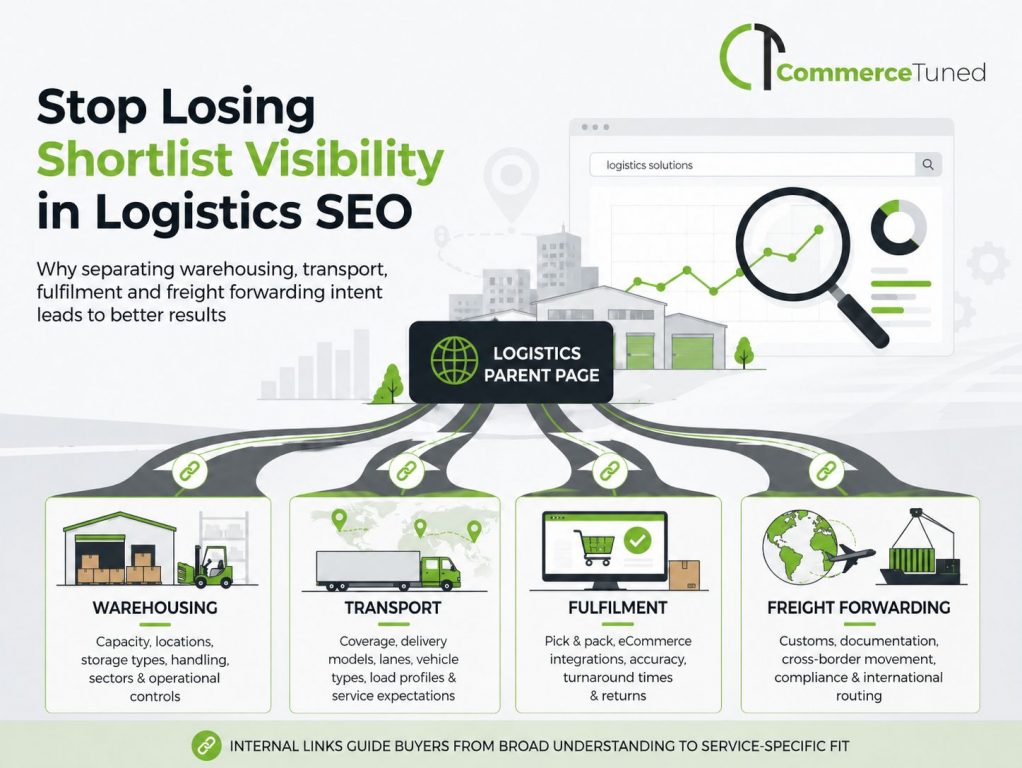
They underperform because warehousing, transport, fulfilment and freight forwarding are collapsed into broad service pages that blur operational fit.
A buyer may find the site, but still leave unconvinced. That is the commercial problem: visibility exists, but shortlist visibility stays weak because the page does not reflect how serious buyers compare suppliers.
Why Logistics SEO Breaks When Different Service Intents Are Forced Into the Same Structure
Warehousing, freight, fulfilment and transport sit close together in the same market, but they are not interchangeable in the buyer’s mind. Each one points to a different operational problem, a different risk profile and often a different internal decision-maker.
This is where logistics SEO often breaks. One broad page can rank for general terms and still fail commercially because it gives every buyer the same answer. Shortlist visibility depends on something sharper:
- fit,
- clarity and
- confidence.
A page has to make the buyer feel that the supplier understands their specific need, not just the sector in general.
Warehousing searches
Warehousing searches often revolve around capacity, locations, storage conditions, handling requirements, inventory control and sector fit. Major providers like DHL and Maersk describe warehousing around dedicated or shared operations, ambient and temperature-controlled facilities, stock visibility, storage, dispatch and warehouse management systems. The buyer is trying to establish whether the provider can store the right goods, in the right place, under the right operational conditions.
Transport searches
Transport searches usually behave differently. They are more likely to centre on lanes, delivery models, service coverage, urgency, vehicle type, load profile or regional availability. Industry sources (1, 2, 3) describe transport planning around trucking lanes, driver capacity, truck space, route guides, shipment patterns and the physical details of the freight itself. The buyer is trying to solve a movement problem, not a storage problem.
Fulfilment searches
Fulfilment searches add another layer. Here, intent often moves towards pick-and-pack capability, ecommerce integrations, inventory accuracy, carrier connections, cut-off times, returns handling and turnaround expectations. UPS defines ecommerce fulfilment around orders being picked from inventory, packed and shipped, while DHL’s fulfilment material highlights same-day dispatch, carrier integration, tracking, returns handling and stock availability. This is where warehousing SEO and ecommerce operational content overlap, but they should not be treated as identical.
Freight forwarding
Freight forwarding SEO brings in still more complexity. The buyer may be thinking about customs, documentation, cross-border movement, compliance, time-critical freight or international routing. UK Government guidance describes freight forwarders as specialists in moving cargo, arranging customs clearance, maintaining documentation and handling border-related requirements. A generic logistics page rarely carries enough precision to satisfy that level of evaluation.
The Structural Mistake That Makes Logistics Sites Sound More General Than They Really Are
The common mistake is architectural, not cosmetic.
Many logistics sites rely on a broad “Our Services” page that lists everything the company can do. It may mention haulage, warehousing, fulfilment, freight, customs and last-mile delivery, but it rarely gives each intent enough room to breathe. The result is a page that sounds comprehensive to the business but vague to the buyer.
Generic location pages create a similar problem. A “logistics company in Manchester” page may capture geographic relevance, but if it does not separate warehousing, transport and fulfilment needs, it still leaves the buyer unsure whether the provider matches the job.
Navigation can also work against the site. Internal business units are not always the same as search behaviour. Buyers do not care how the company organises its departments. They care whether the website helps them reach the right service, route, depot or operational capability quickly.
When intent is mixed too heavily, rankings can weaken because the page lacks focus. Conversion quality can also suffer because the visitors who do arrive are harder to qualify.
What Buyers Need to See Before a Logistics Supplier Makes the Shortlist
A logistics supplier makes the shortlist when the buyer can quickly answer one question: “Can this company handle our specific situation?”
That requires clear service separation. Warehousing, transport, fulfilment and freight forwarding need enough distinction for buyers to recognise their own problem.
It also requires evidence of operational fit:
- the sectors served,
- the types of goods handled,
- the regions covered,
- the routes supported and
- the constraints understood.
This is why a stronger logistics SEO strategy should connect search demand to real services, locations and buying stages, rather than treating every logistics enquiry as one broad category.
Why Generic Page Targeting Misses the Commercial Reality of Logistics Search
Ranking for “logistics company” can look attractive on a traffic report, but it is not the same as being visible when a buyer is close to making a supplier decision.
The commercial value often sits in narrower, more operational searches. These may combine service line, location, route, industry, urgency or handling requirement. They may not produce huge search volumes individually, but together they reveal where real buying intent lives.
Shortlist visibility is not about appearing everywhere. It is about appearing with enough relevance when the buyer is reducing options.
What a Better Logistics SEO Structure Usually Looks Like
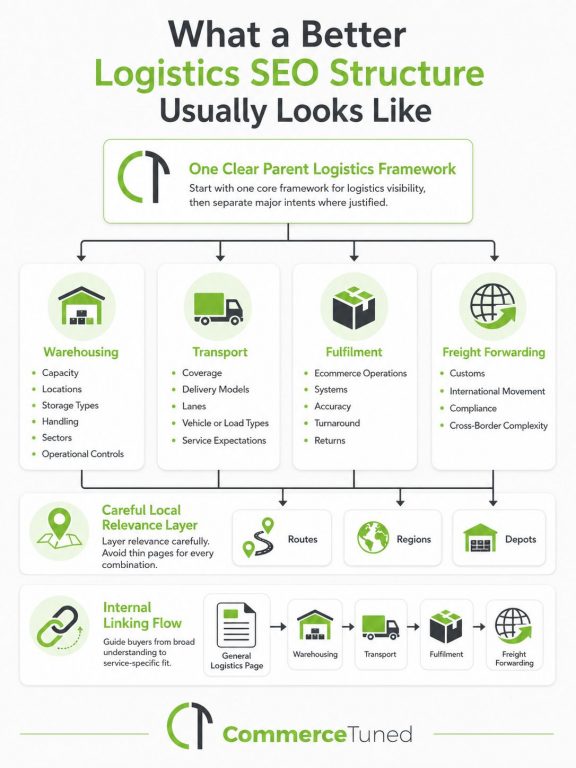
A stronger structure usually starts with one clear parent framework for logistics visibility, then separates major intents where the business model justifies it.
Warehousing should have room to address capacity, locations, storage types, handling, sectors and operational controls. Transport pages should be shaped around coverage, delivery models, lanes, vehicle or load types, and service expectations. Fulfilment content should speak to ecommerce operations, systems, accuracy, turnaround and returns. Freight forwarding content should address customs, international movement, compliance and cross-border complexity.
From there, route, region and depot relevance can be layered carefully. This does not mean creating thin pages for every possible combination. It means building a structure where location and service intent support each other rather than compete.
Internal links should also guide the buyer from broad understanding to service-specific fit. A general logistics page can explain the market context, but it should help users move naturally towards warehousing, fulfilment, freight or transport content when their intent becomes clearer.
The First Pages Logistics Teams Should Review If Enquiries Feel Too Generic
If enquiries feel broad, mismatched or poorly qualified, the first place to look is not always the contact form. It is the structure that sends people there.
Start by reviewing whether warehousing, transport and fulfilment needs are being blended on one page. Then check whether service pages reflect how buyers search or how the business labels itself internally. A buyer-led structure usually performs better than an organisation chart in content form.
Logistics teams should also examine whether routes, regions and services are mapped clearly enough. If a buyer has to work too hard to understand coverage, they may not stay long enough to enquire.
Internal linking deserves the same scrutiny. Does the site help a buyer move from a broad logistics category into a specific capability, or does every page point back to the same generic destination?