
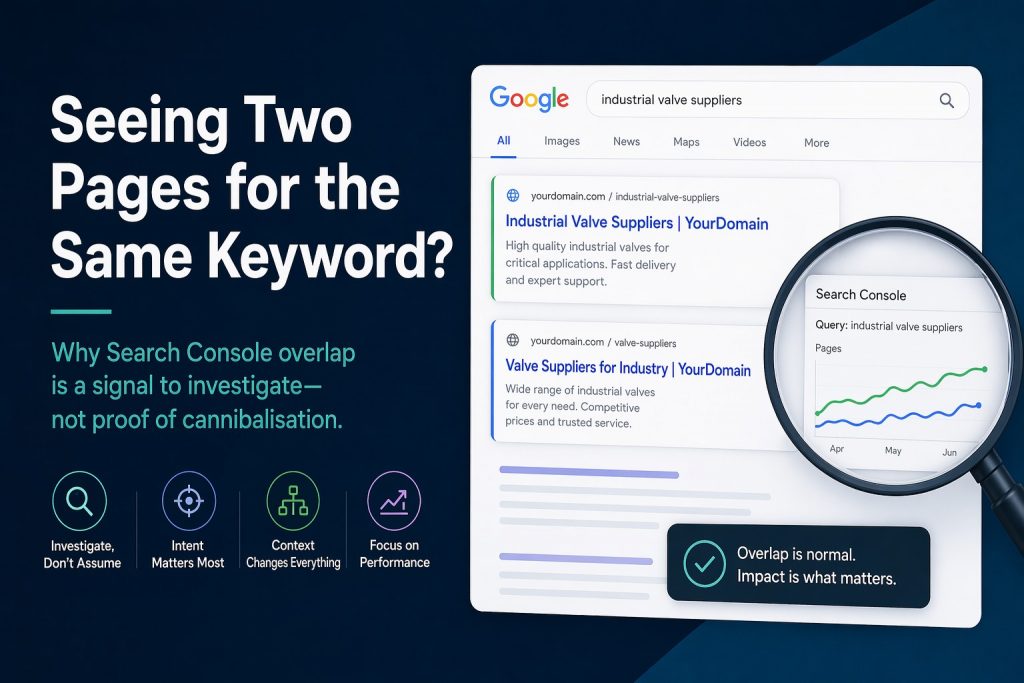
Keyword cannibalisation is one of the most overdiagnosed problems in SEO, especially when teams rely too heavily on Google Search Console. Two URLs appear for the same query, impressions start showing against more than one page, and the conclusion seems obvious: the site has a cannibalisation issue and one of those pages needs to be merged, redirected or rewritten.
In practice, the diagnosis is rarely that simple.
Multiple URLs appearing for the same keyword can mean several different things. Sometimes it reflects unstable page ownership and a genuine performance problem. Sometimes it is just a normal result of how Google evaluates relevance, context and page intent. And sometimes it is a sign that the wrong page is winning, but not for the reasons teams assume when they first export the data.
That is why Search Console overlap should be treated as a signal to investigate, not as proof that keyword cannibalisation is harming performance.
Why Search Console overlap is often misread
Google’s Performance report methodology makes it clear that Search Console is useful for spotting patterns, but it is not designed to give a perfect replay of what happened in a live SERP. At property level, Google aggregates same-property results in ways that can compress same-site appearances, which can make overlap look simpler than it really is. At page level, you can see more detail, but even then you are still looking at recorded visibility rather than a single frozen search result.
That distinction matters.
If two pages appear for the same query in Search Console, you still do not know from that view alone whether Google showed both pages prominently in the same live SERP, alternated between them across dates or devices, or simply gave one page strong visibility while the other appeared only weakly and occasionally.
Those scenarios should not be diagnosed in the same way, because they do not carry the same level of risk.
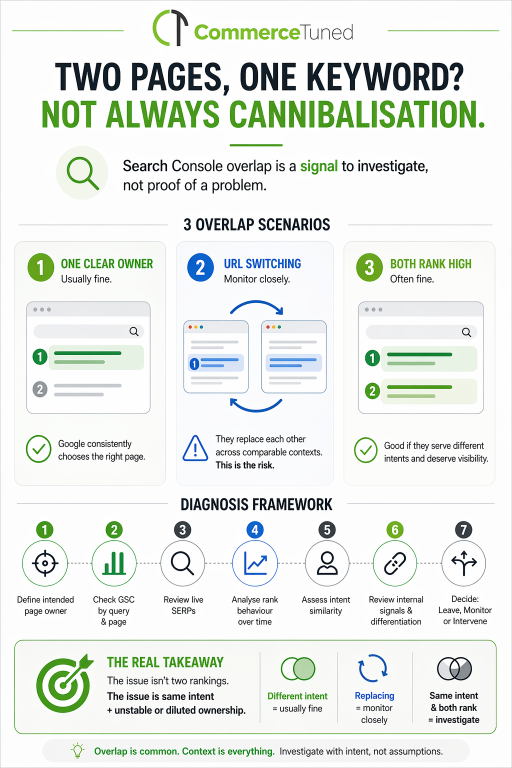
The three scenarios people keep lumping together
One reason keyword cannibalisation gets overstated is that several very different behaviours are treated as though they mean the same thing.
One clear owner with a weak secondary page
The first is the least dramatic: one page clearly owns the keyword cluster, while another page appears only weakly or now and then. That can look untidy in Search Console, but it does not automatically mean the site is underperforming. If the intended page is already the clear winner, the secondary visibility may simply be residual relevance rather than harmful competition.
URL switching across comparable contexts
The second scenario is URL switching. This is more serious, but it still needs context. If Google alternates between two pages across equivalent conditions, that can suggest unclear ownership. But some variation is normal. Google also notes that results can vary by device, location, timing and search context, so not every change in ranking page reflects a real problem.
Two pages ranking prominently in the same SERP
The third scenario is the one that makes people most nervous: both pages ranking prominently in the same visible SERP. Even here, the existence of two URLs is not enough on its own to prove harm. The more important question is whether those pages deserve to share visibility because they satisfy different needs, or whether they are competing for the same search task without enough differentiation.
When overlap is probably benign
Not every case of multiple pages ranking for the same keyword deserves intervention.
If one page is consistently the strongest result, the secondary page is much weaker, and the pages serve meaningfully different intents, the overlap is often low priority. That is consistent with how Semrush frames different-intent overlap and how Ahrefs distinguishes harmful cannibalisation from broader keyword diversification. In those cases, broad changes can create more risk than upside. Teams see overlap in the export, assume cannibalisation, and start rewriting pages that were already doing their job.
That is where overcorrection becomes the bigger problem.
A site can legitimately have more than one relevant page around the same topic area. Google’s site diversity system is a reminder that more than one result from the same site can be normal when it is relevant to the query. Parent and supporting pages, guides and tools, category and subcategory pages, or solution pages and related feature pages can all create overlap in the data without creating a genuine ownership conflict. The real test is not whether the keyword appears across more than one URL. It is whether Google has a clear enough understanding of which page should lead for a specific search need.
What real keyword cannibalisation actually looks like
A more useful definition of keyword cannibalisation is not “two URLs rank for the same query”. It is much closer to the performance-focused framing described by Ahrefs and the same-purpose page definition used by Semrush. It is a situation where two or more pages target materially the same intent and unclear ownership leads to weaker performance than one clearer owner would likely achieve.
That usually shows up in more practical ways.
Sometimes the wrong page outranks the intended page for a commercial or strategic query cluster. Sometimes rankings switch unpredictably across comparable contexts, which makes ownership look unstable rather than context-specific. Sometimes both pages sit within a similar ranking range while doing essentially the same job, which can dilute authority and make it harder for either page to dominate.
Internal signals often make the issue worse. Google’s canonicalisation guidance also reinforces that consistent signals help search engines understand which URL should be preferred. If titles, headings, internal links, copy and hierarchy all blur the distinction between two pages, Google has less reason to prefer one clean owner. In that situation, overlap is not just a reporting detail. It becomes a visibility and prioritisation problem.
Why intent matters more than keyword repetition
The strongest practical rule is that intent similarity matters more than keyword repetition alone. This is also the central distinction in the Semrush cannibalisation guide and the Search Engine Land overview of when overlap becomes harmful.
Two pages can mention the same keyword without creating a real problem if they serve different user needs. That is why branded queries, broad informational searches and multi-intent topics often behave differently from narrow commercial terms. A keyword can be shared across pages while the pages still earn their visibility for different reasons.
The closer the intent match, the more likely the overlap is harmful.
The more distinct the intent, the more likely the overlap is normal or even useful.
That is also why site structure changes the diagnosis. On ecommerce sites, category and product relationships can create legitimate overlap. On editorial sites, closely related articles may need consolidating if they compete for the same search task. On complex B2B and SaaS sites, parent solution pages and supporting feature pages can coexist well, but only when their roles are clearly differentiated. If that distinction is weak, ownership ambiguity becomes much more likely.
How to diagnose cannibalisation properly
A better diagnosis starts with URL-level evidence, not just headline impressions or average position.
First, review query and page data together. Google’s documentation on URL-level and property-level reporting is the reason this matters so much. Look at which URLs are appearing for the same query, then break patterns down by date, device, country and search type where useful. That gives you a much more realistic view of whether there is one stable owner or a more unstable pattern.
Second, check live SERPs representative of the target market. You are not trying to recreate every historical result. You are testing whether apparent overlap looks like a real same-SERP conflict, a context-driven variation, or simply weak secondary visibility.
Third, map intent. Ask whether the two pages actually solve different problems for the user. If they do, overlap may be acceptable. If they do not, the case for intervention gets much stronger.
Fourth, review internal signals. Google’s canonicalisation documentation is especially useful here because it shows how preferred URLs, internal links and consistent signals help clarify ownership. Internal linking, page titles, headings, canonicals and hierarchy should all reinforce which page is meant to own which topic. If the site sends mixed signals, you are more likely to see unstable URL selection.
Finally, triage the issue.
If one page clearly leads and the other is marginal, the case is often benign. If ownership alternates or both pages attract meaningful visibility without a fully clear intent split, the case is worth monitoring. If the wrong page keeps winning, two same-purpose pages sit close together, and internal signals do not clarify ownership, the case is much more likely to be genuinely harmful.
Why the safest SEO move is not always to fix everything
One of the most useful lessons here is that overlapping visibility is not automatically a cleanup project.
SEO teams often treat cannibalisation as a binary issue: either it exists or it does not. But both Ahrefs’ examples of consolidation versus diversification and Search Engine Land’s more nuanced guidance point to a less absolute diagnosis. In reality, the better question is whether the overlap is materially hurting performance. If the intended page is already winning and the overlap is weak, broad changes may do more harm than good. If the ownership is unstable and the wrong page keeps surfacing, then intervention makes more sense.
That kind of restraint is often missing from keyword cannibalisation discussions. For teams working in complex B2B search environments, it is also part of a broader B2B SEO strategy discussion about page roles, intent clarity and prioritisation.
Good diagnosis is not about eliminating every instance of overlap. It is about separating harmless noise from genuine conflicts in page ownership.
The practical conclusion
Two pages appearing for the same keyword is not automatically an SEO problem. That is also the safest reading of Google’s site diversity system and John Mueller’s public comments on same-SERP overlap.
What matters is whether that overlap reflects a real conflict in intent and ownership, or simply normal ranking behaviour across related pages.
Search Console can tell you that overlap happened. It cannot, on its own, tell you whether the overlap is harmful.
That decision requires a deeper look at URL-level data, live SERP behaviour, page intent and internal signals.
So before you merge pages, rewrite content or redirect URLs, make sure you are solving an actual performance problem rather than reacting to a reporting pattern.
Because in many cases, the smarter move is not to fix everything. It is to identify the overlaps that genuinely weaken ownership, and leave the rest alone.