

Low search volume keywords can make B2B SEO look less promising than it really is. A keyword with 20 searches a month may seem too small to matter, especially when compared with consumer markets where thousands of searches can sit behind a single phrase. But in B2B, volume is often a poor proxy for value.
The searches that matter most are not always the ones with the biggest numbers. They are the ones that reveal a buyer is trying to solve a specific problem, compare possible approaches, validate a supplier or understand whether a solution fits their business.
In complex B2B markets, a small number of qualified searches can be more valuable than a large number of vague visits. That is why low search volume keywords need a different prioritisation model. Instead of asking only “how many people search for this?”, the better question is
“what would this search mean if the right person made it?”
Why Low Search Volume Keywords Are Common in B2B SEO
B2B search demand is naturally fragmented. Buyers use industry-specific language, product codes, technical problems, regulatory concerns, procurement terms and internal business language that rarely show up as neat, high-volume keyword groups.
A manufacturer may not search for a broad service term. They may search for a specific production constraint, material compatibility issue or compliance requirement. A logistics buyer may not search for a generic provider category. They may search around routes, warehousing models, fulfilment pain points or sector-specific service needs, which is why SEO for logistics companies needs to reflect how operational buyers actually search.
Keyword tools can underreport this demand because individual queries are dispersed across many long-tail variants. The opportunity is still there, but it does not always appear as one obvious keyword with a reassuring number beside it.
This is why the next step is not to chase bigger numbers, but to separate weak demand from hidden commercial intent.
Low-Volume vs Zero-Volume Keywords
Low-volume keywords and zero-volume keywords are closely related, but they are not the same. Low search volume keywords usually have some reported monthly demand, even if the number is small. Zero-volume keywords are queries where keyword tools show little or no search demand at all.
In B2B SEO, both can still be commercially useful. A zero-volume keyword does not always mean nobody searches for the topic. It may simply mean the query is too niche, too new, too technical or too fragmented for keyword tools to report reliably. This is especially common in markets where buyers use product codes, regulatory language, internal terminology or highly specific problem descriptions.
The distinction matters because low search volume keywords can usually be assessed with a mix of keyword data and commercial judgement, while zero-volume keywords need extra validation.
Before creating content around a zero-volume term, look for supporting evidence from sales conversations, customer questions, Google Search Console impressions, internal site search, proposal feedback or recurring objections from prospects.
For example, a broad keyword may show more demand in a tool, but a zero-volume query linked to a specific technical problem could be more valuable if it reflects how a high-fit buyer describes their need. The goal is not to publish pages for every niche phrase, but to recognise when a small or unreported search pattern points to a real business opportunity.
| Comparison Point | Low-Volume Keywords | Zero-Volume Keywords |
|---|---|---|
| Reported demand | Show a small amount of monthly search volume in keyword tools. | Show little or no reported search volume in keyword tools. |
| Typical B2B use case | Useful for niche services, sector-specific problems and decision-stage searches. | Useful for emerging topics, technical terminology and highly specific buyer questions. |
| Validation needed | Check commercial relevance, buyer intent and whether the topic supports a key page. | Look for evidence in sales calls, GSC impressions, internal search, proposals or customer questions. |
| Main risk | Ignoring valuable searches because the numbers look too small. | Publishing content for phrases that do not reflect real buyer demand. |
| Best approach | Prioritise when the query is commercially relevant and close to a real decision. | Use when there is strong non-tool evidence that the topic matters to buyers. |
The Problem With Judging Low Search Volume Keywords by Volume Alone
Search volume is useful, but it should not be treated as the main decision-making metric in B2B SEO. When it becomes the dominant filter, it can push strategy in the wrong direction.
High-volume keywords often sit too early in the buyer journey. They may attract students, junior researchers, competitors, suppliers, job seekers or people looking for general definitions. Those visits can increase traffic, but they do not necessarily create pipeline.
Lower-volume queries, on the other hand, can reveal stronger commercial intent. Searches around implementation problems, supplier comparison, sector-specific use cases, integration requirements or operational risks may come from people much closer to a serious business decision.
The issue is not that volume should be ignored. The issue is that volume needs context. In B2B SEO, low search volume keywords with strong buying relevance can deserve higher priority than broader keywords with far more searches.
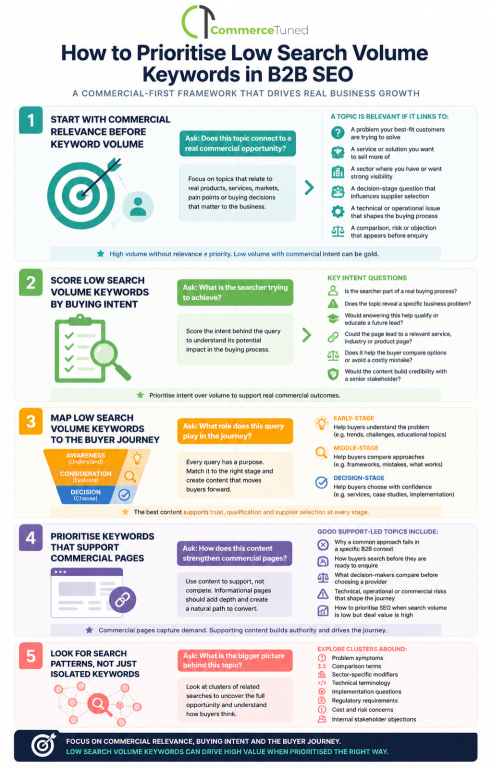
Start With Commercial Relevance Before Keyword Volume
The first step is to assess whether a topic connects to a real commercial opportunity. Before looking at search volume, ask whether the query relates to a product, service, market, pain point or buying decision that matters to the business.
A useful B2B SEO opportunity should usually connect to one of these areas:
- A problem your best-fit customers are actively trying to solve
- A service or solution you genuinely want to sell more of
- A sector where you have experience or want stronger visibility
- A decision-stage question that influences supplier selection
- A technical or operational issue that shapes the buying process
- A comparison, risk or objection that appears before enquiry
If a topic has high search volume but no clear commercial relevance, it should not automatically take priority. If a topic has low volume but sits close to a valuable buying decision, it may be worth pursuing.
For example, a broad keyword such as “digital transformation” may have stronger volume than a niche query around “SEO for technical product catalogues”, but the second query may be much more relevant for a B2B company selling into industrial or manufacturing markets.
Score Low Search Volume Keywords by Buying Intent
Once a topic is commercially relevant, the next step is to understand the intent behind it. In B2B SEO, intent is rarely simple. A single buyer journey may involve researchers, technical evaluators, finance teams, procurement teams and senior decision-makers.
That means a useful topic is not always the one closest to a contact form. Sometimes the right SEO opportunity is a page that helps a buying committee understand the problem better, validate a strategic approach or reduce perceived risk.
You can score low search volume keywords by asking:
- Is the searcher likely to be part of a real buying process?
- Does the topic reveal a specific business problem?
- Would answering this query help qualify or educate a future lead?
- Could the page naturally lead to a relevant service, industry or product page?
- Does the topic help the buyer compare options or avoid a costly mistake?
- Would the content make the company look more credible to a senior stakeholder?
This approach protects the strategy from chasing empty traffic. It also helps prioritise content that supports commercial growth even when keyword volume is modest.
Map Low Search Volume Keywords to the Buyer Journey
Low search volume keywords become easier to prioritise when they are mapped to the buyer journey. Not every query should perform the same role.
Early-stage searches help buyers understand a problem. These may include strategic questions, market shifts, operational challenges or educational searches. They are useful when they attract the right audience and connect naturally to deeper resources.
Middle-stage searches help buyers compare approaches. These can include frameworks, mistakes to avoid, process questions, industry-specific challenges and “what works” topics. These are often highly valuable in B2B because they influence how a buyer defines the solution.
Decision-stage searches help buyers choose a provider or validate a supplier. These may include service-specific terms, sector-specific landing pages, case studies, implementation questions, pricing considerations and proof-led content.
A strong B2B SEO strategy should not reject a query because it is early-stage or low-volume. It should ask what role the query plays. If the topic supports trust, qualification or supplier selection, it may deserve a place in the strategy.
Prioritise Low Search Volume Keywords That Support Commercial Pages
Low search volume keywords work best when informational content supports commercial pages rather than competing with them.
For example, a service page should target the direct commercial need. A supporting blog post can then answer a strategic question that helps the reader understand why that service matters, what goes wrong without it or how to evaluate the right approach.
This is particularly important for B2B companies with multiple sectors, services or technical specialisms. A blog post should not simply duplicate a service page in a softer tone. It should add strategic depth that the commercial page cannot cover fully without becoming too long or unfocused.
Good support-led topics often include:
- Why a common approach fails in a specific B2B context
- How buyers search before they are ready to enquire
- What decision-makers compare before choosing a provider
- Which technical, operational or commercial risks shape the search journey
- How to prioritise SEO when search volume is low but deal value is high
This keeps the site architecture clean. The commercial page captures demand from people looking for a provider, while the blog post strengthens topical authority and creates a natural internal link path.
Look for Search Patterns Instead of Isolated Keywords
In B2B SEO, one keyword rarely tells the full story. A topic may look weak if judged by a single search term, but much stronger when viewed as a cluster of related questions and variations.
A low-volume topic may include searches around:
- problem symptoms
- comparison terms
- sector-specific modifiers
- technical terminology
- implementation questions
- regulatory requirements
- cost and risk concerns
- internal stakeholder objections
When these are combined, the opportunity can be more substantial than it first appears. More importantly, the cluster can reveal how buyers think about the problem.
This is why B2B keyword research should go beyond keyword tools. Sales conversations, customer questions, proposal feedback, CRM notes, support enquiries, competitor pages and LinkedIn discussions can all reveal valuable search opportunities that keyword databases underrepresent.
The goal is to understand the language of the buying process, not just the language of keyword tools.
Examples of Low Search Volume Keywords in B2B Markets
For logistics companies, search demand is often fragmented across services, routes, facilities and sector-specific requirements. A low-volume query around warehousing capacity, fulfilment support for a particular market, freight forwarding for a specific trade lane or 3PL support for a specialist product category may be more valuable than a broader logistics keyword. These searches are often closer to operational need, which means the content should help the buyer understand capability, coverage and suitability.
For manufacturers and industrial businesses, low search volume keywords often appear around technical requirements rather than generic service names. Buyers may search for material compatibility, production tolerances, machinery applications, compliance standards or replacement parts. These queries can look too small in isolation, but they may come from engineers, procurement teams or technical buyers who already know what they need and are trying to shortlist credible suppliers.
For SaaS companies, the best opportunities are often tied to use cases, integrations, migration concerns or comparison-stage searches. A broad SaaS keyword may attract too wide an audience, while a lower-volume query about replacing a specific workflow, integrating with a known platform or solving a compliance issue can reveal a much more qualified prospect. In this context, the content has to connect product value to the problem the buyer is trying to solve, not simply explain the category.
These examples show why low search volume keywords should not be dismissed too quickly. In B2B SEO, the most valuable keyword is not always the one with the largest number beside it. It is often the one that captures a buyer at the point where a specific problem, sector need and commercial decision overlap.
Choose Topics Where You Can Add Real Expertise
When search volume is low, content quality matters even more. There is less room to win by producing generic answers, because the audience is often more specialised and more informed.
A B2B page should show that the company understands the buyer’s context. That means using industry-specific examples, decision criteria, operational details, objections, trade-offs and practical frameworks.
Before approving a topic, ask whether you can add something meaningful:
- Can you explain the problem better than existing results?
- Can you show a real process, framework or decision model?
- Can you include sector-specific examples?
- Can you address objections that competitors ignore?
- Can you connect the topic to business outcomes rather than generic SEO advice?
If the answer is no, the topic may not be worth publishing yet. In low-volume B2B SEO, shallow content can still rank briefly, but it is unlikely to build authority or support meaningful commercial growth.
Build a Practical Framework for Low Search Volume Keywords
A useful way to prioritise low search volume keywords is to score each topic across five areas.
1. Commercial Fit
Does this topic connect to a service, product, sector or problem the business wants to be known for? If not, volume alone should not justify it.
2. Buyer Intent
Does the search suggest a real business problem, comparison process or decision-stage concern? The closer it is to meaningful buyer behaviour, the stronger the opportunity.
3. Authority Potential
Would ranking for this topic strengthen the company’s perceived expertise? Some topics are valuable because they help the brand become associated with a specialist area.
4. Internal Link Value
Can the content naturally support an important commercial page? If a blog post cannot link to a relevant service or industry page without forcing it, the topic may be weaker than it first appears.
5. Content Advantage
Can you create a page that is genuinely more useful than what already exists? If competitors are thin, generic or focused on the wrong audience, the opportunity may be stronger even with low volume.
When Low Search Volume Keywords Should Be Rejected
Not every low-volume keyword deserves content. Some topics are too narrow, too disconnected from revenue or too difficult to support with meaningful insight.
A low-volume topic should usually be rejected when:
- It has no clear connection to a commercial page
- It attracts the wrong audience
- It cannot be answered with genuine expertise
- It overlaps too closely with an existing page
- It is only being considered because a competitor mentioned it
- It would create thin content or unnecessary site clutter
- It does not support search demand, internal linking or authority-building
B2B SEO is not an excuse to publish endlessly around every niche phrase. The goal is to create a focused body of content that helps the right buyers move from problem awareness to supplier confidence.
What Low Search Volume Keywords Mean for B2B SEO Strategy
Low search volume keywords should not discourage B2B companies from investing in SEO. They should encourage better prioritisation.