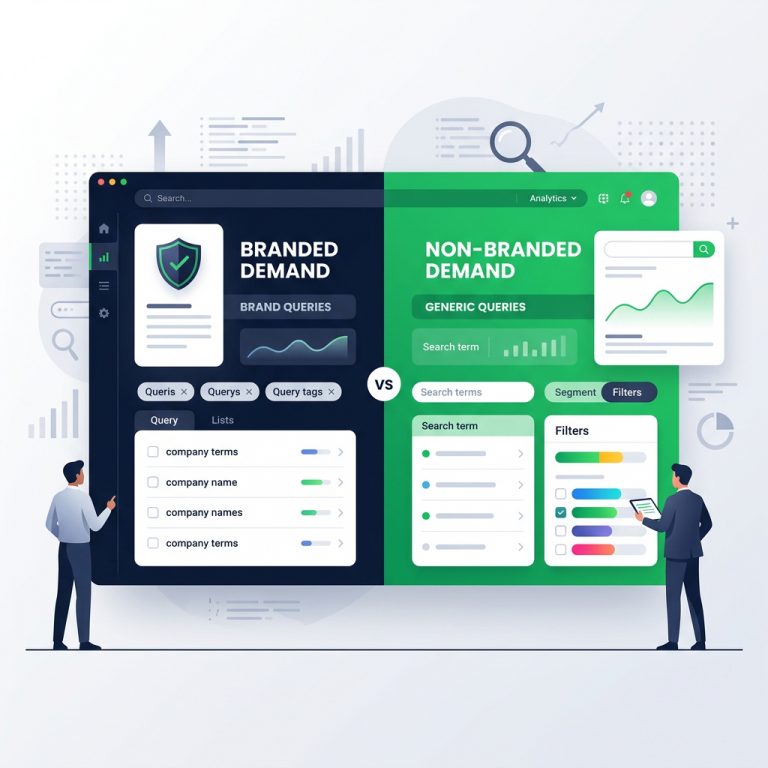
Most B2B teams talk about brand demand with more confidence than their data deserves. For years, branded versus non-branded reporting has relied on manual filters and rough regex logic, then been treated as if it showed how much real demand the brand had created. It did not.
That is why Google’s branded queries filter matters. It gives marketers a more credible way to separate familiarity from discovery and to see whether SEO is only generating discovery, or whether it is also helping create the kind of recall that shapes shortlists and buying decisions later on.
What the branded queries filter changes in practice
The shift is simple: instead of approximating brand performance with manual query filters, you can now use Google’s own branded classification layer. That means spelling variations, product names and other brand-related searches are more likely to be captured than they would be with basic regex rules.
It is still not perfect, but it is a more intelligent way to separate branded familiarity from non-branded discovery than the old manual workaround.
What happens when your domain is also a keyword
Some sites use a domain or brand name that is also a general market term. In those cases, the boundary between branded and non-branded intent is much less obvious, because the same word can refer either to a company or to a category.
This filter can become a useful way to understand how Google is classifying intent in practice. However, Google does not publish the exact decision logic for domains that are also generic keywords.
What the filter gives you, then, is a practical read on how Google appears to interpret those searches. If a keyword that matches your domain is consistently classified as branded, that suggests Google has enough contextual signals to treat that term as a navigational or brand-led search in at least some cases. If similar queries remain non-branded, that suggests Google is still reading them primarily as general discovery queries tied to the category rather than the company.
Over time, that can tell you whether your market presence is strong enough for a once-generic phrase to be interpreted more often as your brand.
It can also reveal where the line still sits. For example, you may find that the exact domain term is treated as branded, while broader variations around it still fall into the non-branded segment. That is a useful distinction. It tells you that Google may recognise the brand entity itself, but not yet treat the wider phrase set as brand-led intent.
For B2B marketers, this can be particularly useful in three situations.
- First, it helps when reporting on exact-match or partial-match domains that would otherwise make manual branded filtering unreliable.
- Secondly, it can show whether brand recognition is becoming strong enough to reshape how ambiguous searches are interpreted.
- Thirdly, it gives you a more informed way to discuss whether search growth is coming from category-level visibility or from Google increasingly understanding that the category term is also your brand.
What branded query growth can really signal
The first useful point is that branded query growth can indicate rising recall rather than just rising traffic. If more people are searching for your company, product or closely associated offer after discovering you elsewhere, that often suggests your brand is beginning to stick. In B2B, that can be commercially significant because the shortlist is often shaped long before a demo request appears.
The second point is that branded query growth can show that your non-branded visibility is starting to convert into memory. This is where the relationship between the two segments becomes more interesting than either number on its own. If non-branded search visibility improves first and branded searches rise later, that can suggest your organic presence is doing more than attracting clicks. It is helping your market remember you.
The third point is that branded searches often signal validation behaviour. Prospects searching your name may be looking for your homepage, reviews, leadership profiles, pricing cues, case studies or reassurance that you are a credible option. In that sense, branded search is often closer to decision support than to pure awareness.
That is also why branded search performance should not be read only as a volume story. The shape of the branded traffic matters too.
Higher branded impressions with weak click-through rate can imply that more people recognise the name but still do not find the result compelling enough to click. Strong branded click-through rates, by contrast, often suggest that your SERP presence aligns with buyer expectation.
What the filter still cannot tell you on its own
The branded queries filter is useful, but it is not a complete measure of brand demand. Classification will not always be perfect, not every brand interaction leads to a branded search, and some branded spikes may reflect PR or visibility rather than commercial intent.
That is why the strongest use of the filter is comparative rather than absolute. It helps you read direction and relationship, not produce a final verdict on brand demand by itself.
How B2B marketers should read branded and non-branded movement together
The most useful analysis usually starts with the gap between branded and non-branded performance, not with either segment in isolation.
- If branded search is rising while non-branded visibility stays flat, you may be strengthening recognition among people who already know the market, but not expanding discoverability enough to grow future demand.
- If non-branded visibility is rising while branded search stays weak, you may be winning more attention in the category without yet creating strong brand memory.
- If both are rising together, that is often the healthiest pattern because it suggests search is supporting both discovery and recall.
This is also the point where Search Console should be connected back to broader commercial context. Campaign launches, trade events, PR coverage, category shifts and changes in sales activity can all influence the branded split. Used properly, the filter should sharpen interpretation, not replace it.
For teams trying to strengthen how they appear when prospects search them by name, the quality of the branded results page matters as much as the volume behind it. That is where a broader search engine reputation management view can become relevant, especially when executive stakeholders or procurement teams are using branded search as a quick credibility check.
Why the split matters more than the numbers
The mistake is to treat branded search as proof of success and non-branded search as proof of SEO. On their own, both can mislead. Strong branded growth may reflect existing awareness more than new reach, while strong non-branded growth may still fail to create remembered preference.
What matters is the relationship between the two. That is what makes the branded queries filter useful in B2B reporting. It helps marketers show whether search is mainly capturing existing demand, building future demand, or supporting both at once.
That is the real value of the filter. It does not just tell you who already knows your brand. It gives you a better way to judge whether search is helping your brand become easier to remember, easier to trust and easier to choose.