
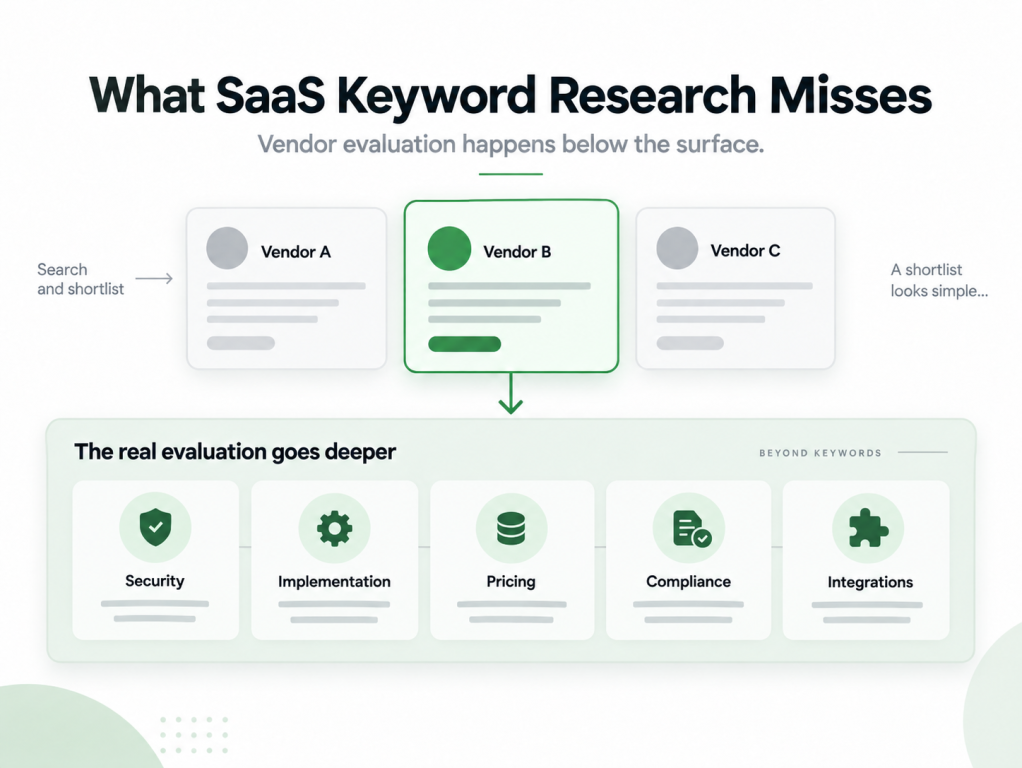
Enterprise SaaS buyers rarely reach a demo with a blank page and an open mind.
They have researched the market, compared potential suppliers, discussed requirements internally and, increasingly, formed a preference before a salesperson enters the conversation.
That changes what search needs to do for a SaaS business.
Traditional keyword research is good at finding visible demand: category searches, software comparisons, alternatives, integrations and use cases.
But enterprise SaaS vendor evaluation also creates another layer of search behaviour around implementation, security, compliance, pricing, data handling and operational risk.
Some of those searches have modest measurable volume. Others are brand-specific enough that conventional keyword tools can make them look insignificant.
Commercially, they can be anything but insignificant.
What Buyers Are Already Trying to Establish
Before Sales Engagement
What Keyword Research Usually Sees
The Validation Layer That Is Easier to Miss
Enterprise evaluation creates commercially important questions that conventional keyword research can easily underrepresent.
SaaS Vendor Evaluation Starts Before the Demo
Research from 6sense illustrates just how developed B2B buying decisions can be before sellers become involved. Its 2025 Buyer Experience Report found that 94% of buying groups were able to put their shortlist in order of preference before engaging sellers.
Buyers initiated the first interaction in 79% of cases, and nearly 80% ultimately stayed with the vendor they initially preferred.
6sense describes two points of consensus. Buyers first establish a preferred supplier independently, then use demonstrations, sales conversations and commercial negotiations to validate that choice.
Product capabilities, ease of implementation and price are among the leading reasons buyers ultimately select a vendor.
For SaaS marketers, that creates an important distinction.
A website may not formally complete the sale before the demo, but it can do much of the work that determines who is most likely to win it.
If buyers are already selecting a preferred vendor before speaking to sales — and that preferred vendor goes on to win around four out of five times — then pre-demo research is not simply about making the shortlist.
It is about becoming the supplier the buying group already expects to choose.
The demo and sales process still matter, but increasingly they act as a validation stage: confirming product capabilities, implementation realities, commercial terms and risks before the organisation commits.
That is where a broader approach to enterprise SaaS SEO becomes important. Search should not stop at generating awareness or capturing buyers looking for a software category. It should also help the right supplier become visible and credible while buyers are still comparing options and forming a preference.
It should also support the questions that appear once a buyer starts asking whether a particular vendor will actually work for their organisation.
Much of the Decision Is Already Taking Shape
How the Buying Decision Develops
The SEO implication: the website is not only trying to get onto the shortlist. It can help determine which supplier enters the sales process as the buyer’s preferred choice.
Enterprise SaaS Buyers Need to Prove More Than Product Fit
The familiar SaaS journey often revolves around product fit: does the platform have the features the buyer needs, and does it solve the right problem?
Enterprise purchases introduce several other forms of fit.
A Product Can Be a Good Fit and Still Fail the Buying Process
Different stakeholders need to establish different forms of fit before an enterprise SaaS purchase can move forward.
Features, capabilities, use cases and how the product compares with alternative solutions.
Integrations, APIs, identity management, infrastructure requirements and technical compatibility.
Migration, onboarding, internal resources, dependencies and the path towards adoption and time to value.
Security, privacy, compliance, data location, subprocessors and governance requirements.
Pricing, contract structure, total cost, expected value and the business case required by finance and procurement.
This is why enterprise SaaS websites need more than feature and solution pages. Different members of the buying group may be validating completely different things, often using search language that does not resemble the terminology used by the marketing team.
Security Searches Can Represent Formal Due Diligence
Security provides perhaps the clearest example.
Someone searching for a vendor’s SOC 2 status, ISO certification, data residency policy or list of subprocessors may generate only one visit.
But that visitor could be part of the team deciding whether a six-figure software purchase can progress.
In some situations, they are also carrying out a formal responsibility.
The UK’s National Cyber Security Centre guidance says organisations should carry out due diligence on the security of a SaaS offering before deployment. Its guidance is aimed specifically at risk owners and IT deployment teams evaluating whether SaaS can be used with sufficient confidence.
Data protection creates additional scrutiny. The Information Commissioner’s Office guidance states that organisations acting as controllers must only use processors that provide sufficient guarantees around appropriate technical and organisational measures.
It identifies documentation, industry standards, technical expertise and security practices among the factors organisations may need to assess.
Cloud-security frameworks formalise the process further. The Cloud Security Alliance’s CAIQ guidance explains how its questionnaire can be used to assess the security practices of cloud providers, while its STAR framework supports vendor-security assessments.
One Search Can Sit Inside a Much Bigger Buying Decision
A highly specific branded query can be part of a formal process for determining whether a SaaS supplier is acceptable.
What a reviewer may be trying to validate
The SEO distinction: a query such as
[vendor] data residency UK can look insignificant when judged
by search volume alone. Within an active enterprise opportunity, failing
to answer it clearly can become a sales problem.
Evaluation Is Becoming the Hard Part of Buying Software
The pressure is not limited to security.
G2’s 2026 Buyer Behavior Report found that 40% of software buyers now regard evaluation as the longest part of the buying journey.
Once a shortlist exists, IT security review is the most commonly reported cause of delay at 39%, rising to 50% among enterprise buyers.
Budget approval follows at 32%, while implementation planning accounts for 25%.
This suggests a useful shift in how SaaS content opportunities are evaluated.
Finding Software Is Only Part of the Journey
Once buyers have a shortlist, the difficult questions increasingly concern whether a preferred solution can actually be approved and implemented.
What Could Solve This Problem?
Buyers are identifying possible solutions and narrowing the market.
Can This Particular Solution Survive Our Requirements?
The question moves from potential fit to whether the organisation can actually approve the purchase.
For SEO, the shift matters: integration pages, comparison content, pricing information, security centres, implementation guides, migration documentation and procurement resources are not simply bottom-of-funnel assets. They can provide the evidence required to move an active software purchase forward.
Why Keyword Research Can Miss Valuable SaaS Searches
Conventional keyword research depends heavily on aggregated demand. That creates problems when enterprise buying behaviour is fragmented across products, companies and individual stakeholders.
A broad query such as CRM software can accumulate significant
search volume because thousands of unrelated buyers use roughly the same words.
A validation query may look more like:
Commercial Intent Does Not Always Concentrate Into Large Keywords
Enterprise evaluation can fragment valuable demand across highly specific vendor and requirement combinations.
Aggregated Category Demand
Many different buyers express a similar need using the same broad query.
Fragmented Validation Demand
Individual buyers ask highly specific questions about a particular supplier, product or organisational requirement.
[vendor] SSO Azure AD
[vendor] SOC 2
[vendor] implementation time
[vendor] API limits
[vendor] data export
[vendor] SLA
[vendor] UK data hosting
[vendor] enterprise pricing
The demand exists, but it is distributed. Each SaaS product generates its own combinations of brand, requirement and stakeholder questions.
Each product creates its own variations. The resulting demand is distributed across thousands of brand-and-requirement combinations rather than concentrated in one attractive keyword.
That makes aggregate volume a weaker proxy for commercial value.
It also means a SaaS company can have real unmet search demand that does not appear prominently in a conventional keyword report.
This is why our wider approach to mapping B2B SEO to buying stages matters particularly in SaaS. The value of a search should partly depend on what the person is trying to establish and how that information influences a purchase, not only on how many people type the same words each month.
Find Validation Demand Inside the Business
If keyword tools cannot reveal the whole picture, SaaS SEO research needs additional inputs.
Sales teams are an obvious starting point. Questions repeatedly raised before or after demos can expose information buyers were unable to find independently.
Security questionnaires can be even more revealing. If prospects repeatedly ask where data is hosted, which subprocessors are used, whether SSO is supported or how data is deleted after termination, those are not hypothetical content ideas. They are recurring buyer requirements.
Implementation teams can identify another set of gaps. Migration complexity, required integrations, customer responsibilities and realistic rollout times are often commercially important even when their search volumes are small.
Customer success and support teams can contribute as well. Questions that repeatedly appear after purchase sometimes expose information that would also help prospects assess the product beforehand.
Procurement and lost-deal feedback can complete the picture. If deals repeatedly slow down because buyers cannot establish contract flexibility, total cost, security readiness or implementation effort, the website architecture should be reviewed alongside the sales process.
The Business Already Contains Evidence of What Buyers Need to Know
Repeated questions, objections and approval requirements can reveal commercially important search opportunities that aggregated keyword data does not.
Look for questions, objections and requirements that appear repeatedly across real opportunities.
Determine what the buyer is actually trying to prove: technical, operational, risk, product or economic fit.
Turn repeated, useful validation requirements into accessible content where independent buyers would benefit from finding the answer.
Before creating a page, ask:
The objective is not to turn every internal question into an SEO page. It is to use real buyer behaviour alongside search data to identify recurring validation needs that deserve to be discoverable.
Decide What Should Be Public and Searchable
Not every validation asset needs to be public. The more useful question is which information buyers repeatedly need before they can decide whether further evaluation is worthwhile.
A simple rule is to make information public when it answers a recurring buyer question, can be shared safely, helps a prospect assess fit and would otherwise create unnecessary friction by forcing the buyer to ask sales.
When Does Validation Information Deserve to Be Searchable?
Public content should remove recurring evaluation friction without exposing information that genuinely needs tighter control.
Recurring Evaluation Information
Sensitive Evidence
The goal is not maximum transparency. It is to make the recurring parts of vendor evaluation easy to find while keeping genuinely sensitive evidence appropriately restricted.
Validation Pages Need to Answer Real Questions
Simply creating the expected URLs is not enough.
A security page consisting of logos and reassurance language may technically exist while failing to answer the questions a security reviewer actually has.
An implementation page saying onboarding is “simple and seamless” provides little help if buyers need to know whether migration requires technical resources, how long the principal stages normally take or what systems need to be integrated.
A pricing page can present attractive packages while avoiding the commercial variables that matter in an enterprise deployment.
Good validation content reduces uncertainty.
Reassurance Copy Is Not the Same as Evaluation Evidence
The page becomes useful when it helps the buyer resolve a real question rather than simply confirming that the vendor offers something.
Certification logos, generic claims and broad reassurance without enough detail to complete an assessment.
Certifications, authentication, data residency, subprocessors, encryption and where deeper evidence can be obtained.
Positive language without explaining what implementation actually requires from the customer.
Typical stages, migration requirements, integrations, customer responsibilities, dependencies and where complexity can vary.
No indication of the variables, commitments or additional costs that shape an enterprise purchase.
Pricing logic, major cost drivers, onboarding costs, contract considerations and enough context to judge whether evaluation is viable.
Good validation content reduces uncertainty. The objective is not simply to create the right page type, but to give that page a defined role in helping a buyer evaluate the product.
AI Makes Clear Validation Information More Important, Not Less
AI is accelerating software discovery, but the available evidence suggests it has not removed the need for vendor validation.
That matters because AI can influence which suppliers buyers encounter before they visit a vendor website. We have explored this more broadly in our analysis of AI search and B2B shortlist visibility .
G2’s 2026 Buyer Behavior Report found that eight in ten buyers have sourced software recommendations from AI tools during the previous two years, while simultaneously finding that evaluation has become the longest phase of the purchasing journey.
AI can make it easier to identify possible suppliers. It does not necessarily make it easier to establish whether one of those suppliers can satisfy an organisation’s security, implementation, commercial or governance requirements.
6sense’s 2025 Buyer Experience Report found another interesting effect. Buyers increasingly needed clarification about AI functionality itself — including capabilities, pricing, implementation and security — and 58% said uncertainty around AI caused them to engage vendors earlier than they otherwise would have.
The research also notes that buyers often could not find the answers they needed on vendor websites.
For SaaS businesses adding AI features, that creates another validation layer. Buyers may need to understand what data is used, how models are involved, what additional costs apply, what changes in implementation and what governance controls exist.
Again, keyword demand alone may not tell the story.
Easier Discovery Can Create More Questions to Validate
AI can shorten the path to a shortlist, but enterprise buyers still need evidence before a supplier can progress.
Buyers can ask for recommendations, comparisons and possible solutions without manually researching every vendor.
AI can accelerate market research, but the organisation still has to establish which suppliers deserve serious consideration.
Security, implementation, pricing, governance and technical requirements still have to be resolved before the purchase can progress.
AI-enabled SaaS can introduce additional validation questions
The search implication: AI visibility and vendor discoverability matter, but they need to be supported by content that helps buyers verify what they find. A broader AI SEO strategy therefore needs to consider both whether a SaaS brand can be discovered in AI-influenced search and whether its website provides enough structured, accessible evidence for subsequent evaluation.
A Better Way to Prioritise Enterprise SaaS Content
The strongest SaaS SEO strategies still need keyword data. Search volume, rankings, competitive visibility and SERP intent remain useful ways to identify opportunities.
They simply should not be the only evidence.
For enterprise SaaS, a more complete prioritisation model asks three questions.
Three Questions Are More Useful Than Search Volume Alone
Search demand still matters, but it should be considered alongside what buyers repeatedly need to establish and how that information affects the purchase.
Use keyword data, rankings, SERP intent and competitor visibility to establish whether there is measurable external demand.
Look at sales conversations, security reviews, implementation questions, procurement requirements and recurring objections.
Consider whether the information could help a qualified prospect evaluate, shortlist, justify or approve the product.
How to interpret the result
There is measurable demand, buyers repeatedly need the information and answering the question can influence evaluation. The case for prioritising the content is strong.
The content may still deserve priority. Low aggregate demand does not make a recurring validation requirement commercially unimportant.
This is the central point: the searches that influence a complex SaaS purchase are not always the ones with the largest numbers beside them. Sometimes one technical evaluator, security reviewer or finance stakeholder is asking the question that determines whether the preferred vendor can move forward.