
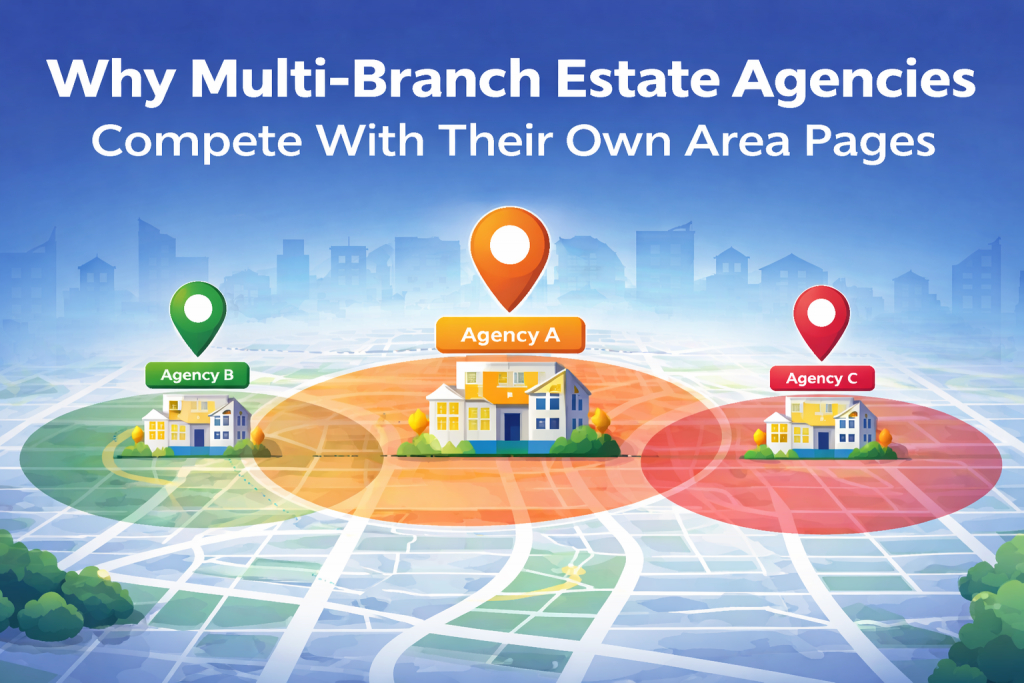
Many multi-branch estate agencies assume weak visibility is driven by property portals or competing agents. In reality, the issue is often internal. Their own branch pages, area guides and local landing pages frequently overlap, diluting visibility and confusing search engines.
This is not just a rankings issue. It is a structural visibility problem. When multiple pages target similar locations, audiences and intent, Google struggles to determine which page should rank.
Generic local SEO advice rarely addresses this. Most frameworks assume a single office with a clearly defined territory, not an agency operating across overlapping patches and multiple branches.
The agencies that perform consistently tend to do one thing differently: they separate branch intent, area intent and valuation intent clearly across their site.
Why local SEO becomes more complex for multi-branch estate agencies
Local SEO gets harder as an estate agency expands because scale creates overlap. More branches usually mean more towns covered, more area pages and more chances for different URLs to target the same intent.
That overlap is rarely obvious at first. Neighbouring branches often cover similar postcodes, branch pages and area guides mention the same places, and new local pages are added for coverage without a clear commercial role. Over time, several pages start targeting similar seller, landlord or “near me” searches.
This is also why generic local SEO advice tends to fall short. Most advice assumes one office with one defined footprint. Multi-branch estate agencies operate differently. Their patches overlap, their coverage changes and multiple branches may need visibility in the same town for different reasons. The real issue is not just page optimisation. It is whether the site structure makes each page’s purpose clear.
How estate agency area pages start competing with each other
Too many pages target the same local intent
Several URLs end up chasing slight variations of the same search, whether that is selling in a town, valuing a home in a postcode or finding an estate agent nearby.
Branch pages and area pages blur into one another
When both page types target the same place names, Google gets weaker signals about which URL should rank, so visibility shifts between them.
Templates create similarity at scale
Repeated page structures and similar copy across branches, towns and patches make it harder to differentiate one local page from another.
Internal links reinforce the wrong hierarchy
Navigation and contextual links often support the pages that were easiest to publish, not the pages with the clearest strategic role, which is exactly why internal link structure matters.
The warning signs that your estate agency is cannibalising its own local SEO
There are several indicators that internal competition may be affecting your visibility:
- Different pages alternating rankings for the same search theme
- Branch pages and area pages outranking each other inconsistently
- Weak visibility despite strong local relevance
- New pages causing existing pages to lose traction
- Multiple pages with very similar titles, headings or location targeting
What Google actually needs to understand on a multi-branch property site
For a multi-branch estate agency, the goal is not simply to create more local pages. It is to help Google understand the role of each page within the site.
This requires a clear separation of purpose.
- Branch pages should establish trust, coverage and contact intent at a local office level.
- Area pages should focus on location-specific relevance, including valuation intent and local demand signals.
- Property listings should capture stock-level visibility and transactional searches.
- Guides and blog content should support research behaviour, provide context and reinforce internal linking between key pages.
Clarity of purpose matters more than page volume. When each page type has a defined role, the entire site becomes easier to interpret.
How to structure a multi-branch estate agency site without internal competition
An estate agency with three neighbouring branches can reduce internal competition by using a simple structure that keeps branch, area and valuation intent separate.
- Assign one primary branch to each town: Decide which office is the main local authority for each area, even where nearby branches still support it commercially.
- Give each page a single job: Keep branch pages focused on trust, coverage and contact, while area pages target local demand and valuation intent.
- Avoid duplicate area targeting: Do not let multiple pages chase the same seller or landlord search unless there is a clear reason and clear differentiation.
- Differentiate area pages by audience: Some towns may need a seller-focused page, others a landlord-led angle or a more buyer-oriented local guide.
- Align internal links with territory ownership: Link branch pages, area pages and supporting content in a way that reflects the real patch structure.
- Keep Google Business Profiles consistent with the site: Branch-level local signals should support the same geography and intent shown on the website.
This creates a healthier site structure. Google can see which page represents the branch, which page represents the area and how the supporting content fits around them. That makes visibility more stable and reduces the risk of pages competing with each other.
Why stronger local SEO for estate agents starts with page purpose, not page volume
Creating more local pages does not automatically improve visibility.
For multi-branch estate agencies, the key is structure. Clear hierarchy, defined roles and intentional differentiation between pages have a far greater impact than simply increasing page count.
When branch pages, area pages and supporting content work together, local SEO becomes more stable and more commercially effective.
This is where a more structured approach to patch-level local SEO for estate agents makes the difference, especially for agencies operating across overlapping territories.