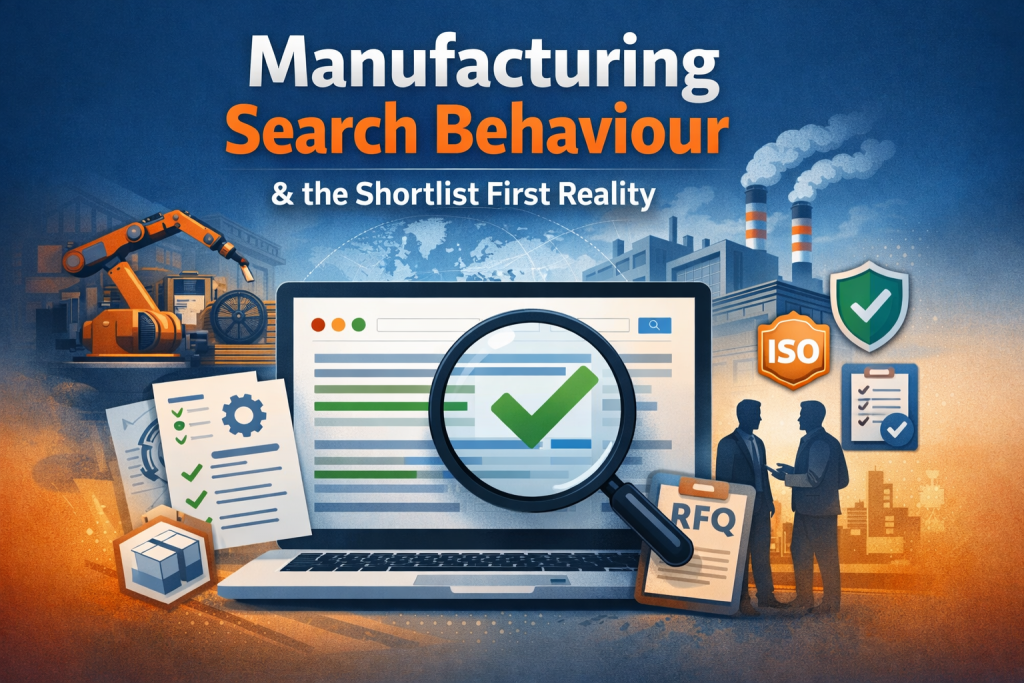
Manufacturing search behaviour is often misunderstood because it is analysed through a generic digital marketing lens rather than through procurement psychology. In mid-to-large industrial firms across the UK, Europe and North America, search is rarely an open exploration of dozens of unknown suppliers. More often, it is a structured validation process shaped by risk, compliance requirements and internal stakeholder alignment.
This article examines how decision-makers in manufacturing companies actually use search engines during supplier selection. Drawing on research from Gartner, McKinsey, Forrester and Google’s B2B studies, we separate evidence from inference and identify what this means for industrial visibility.
How industrial buyers actually search
Evidence
Gartner research consistently shows that B2B buying groups involve 6–10 stakeholders, each conducting independent research before consensus is formed. CEB (now part of Gartner) found that buyers complete 57–70% of their decision journey before contacting a supplier representative.
McKinsey’s B2B Pulse studies (2021–2023) indicate that decision-makers increasingly rely on digital self-service and third-party information during supplier evaluation. However, the research also shows that industrial buyers favour known vendors and prior relationships when available. Trust and perceived risk reduction often outweigh marginal differences in features or price.
Google and BCG research into complex B2B purchases highlights that buyers cycle between problem identification, solution exploration, requirements building and supplier selection multiple times before final commitment.
Interpretation
In manufacturing environments, this translates into:
- Highly specific technical queries
- Brand-led searches once a shortlist is defined
- Deep review of specification pages and downloadable documentation
- Cross-checking of claims through third-party sources
Search is rarely a broad, category-level comparison of unknown suppliers. Instead, it supports structured evaluation
Shortlist-first behaviour in manufacturing procurement
Evidence
Academic procurement research in industrial sectors consistently shows that supplier evaluation is risk-weighted. Existing relationships, certifications and prior performance heavily influence inclusion in tender or RFQ processes.
McKinsey’s B2B research consistently shows that supplier preference, trust and confidence-building information play an outsized role as decisions progress, especially for larger, higher-risk purchases.
Gartner notes that buying groups seek “confidence-building information” to reduce internal disagreement and perceived risk.
Interpretation
In practice, shortlist formation often occurs before heavy search activity begins, with many buyers already having preferred vendors in mind. This is reinforced by the “day-one shortlist” findings in 6sense’s B2B Buyer Experience research. Sources influencing early shortlists include:
- Trade exhibitions and industry events
- Distributor relationships
- Peer recommendations
- Legacy supplier relationships
- Industry publications
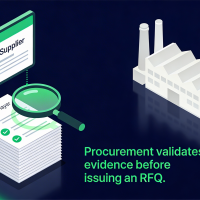
Search then plays a secondary but critical role: validating the shortlist.
This validation includes queries such as:
- “[Supplier name] ISO 9001 certification”
- “[Supplier name] compliance documentation”
- “[Supplier name] case study automotive sector”
- “[Supplier name] financial stability”
The behaviour is therefore validation-driven rather than discovery-driven in many established manufacturing contexts.
Discovery search vs validation search
Discovery search characteristics
- Broader category queries
- Emerging technology exploration
- Geographic expansion sourcing
- New supply chain disruption scenarios
Validation search characteristics
- Branded queries
- Certification and compliance checks
- Technical specification confirmation
- Case studies and sector relevance
- Executive or company background research
Evidence
Google’s B2B research highlights the importance of brand signals and confidence-building information as buying groups move toward decision-stage validation.
Forrester’s Buyers’ Journey Survey findings are widely summarised as showing buyers often enter buying processes with preferred vendors and use research to confirm. A public summary citing those results is here.
Interpretation
Manufacturing buyers use Google in two distinct modes:
- Exploration mode (early, technical stakeholders often involved)
- Validation mode (later, procurement and senior stakeholders involved)
In mature industrial categories, validation mode dominates volume patterns.
The psychology of long procurement cycles
Evidence
Industrial procurement cycles frequently extend from 6 to 18 months, particularly in capital equipment and engineering-heavy purchases. Risk mitigation is consistently identified as a primary driver of decision delay.
Gartner’s buying-journey research highlights buying-group complexity and the need for confidence-building information to reduce internal friction during decisions.
Interpretation
Long cycles create repeated search behaviour rather than linear funnels. Buyers revisit suppliers multiple times to:
- Reconfirm technical suitability
- Check updated compliance status
- Review new case studies
- Validate claims presented in sales discussions
Search behaviour therefore reflects reassurance and internal validation, not rapid comparison shopping, which is why what your brand looks like in Google results can influence internal sign-off.
Role-based differences in search behaviour
Engineers
- Focus on technical depth
- Download specification sheets
- Evaluate performance data
- Compare tolerances and standards
Engineers are more likely to conduct early discovery research but shift to detailed validation once a shortlist exists.
Procurement managers
- Check compliance and certifications
- Assess financial stability
- Evaluate contractual risk
- Confirm supplier legitimacy
Search activity is often brand-specific and risk-oriented.
Operations directors
- Assess implementation feasibility
- Look for case studies in similar manufacturing environments
- Evaluate service reliability indicators
Their searches frequently include sector modifiers.
PrC-level stakeholders
- Brand reputation checks
- Media coverage
- Executive credibility
- Strategic alignment
Branded search and reputation signals dominate.
Importance of certifications and technical documentation
Evidence
Industrial buyers consistently rank compliance and quality assurance as primary evaluation factors. ISO certifications, CE markings and sector-specific standards significantly influence supplier credibility.
McKinsey’s research into industrial purchasing highlights quality assurance as a top-three buying factor across heavy industry.
Interpretation
Search queries frequently include:
- Certification numbers
- Regulatory standards
- Industry-specific compliance terminology
- PDF specification searches
Technical documentation is not supporting content in industrial SEO; it is often central to validation behaviour.
Contradictions with common SEO assumptions
Common assumption: High traffic equals influence.
Reality: In manufacturing, small volumes of high-intent validation queries often matter more.
Common assumption: Generic category rankings drive growth.
Reality: Branded visibility and compliance signals often influence shortlist survival.
Common assumption: Top-of-funnel content scales pipeline.
Reality: Risk-reduction content frequently drives later-stage inclusion.
Implications for Industrial Search Strategy
- Visibility must support validation, not just discovery.
- Branded search experience becomes strategically critical.
- Certification and compliance content should be structured, indexable and easily accessible.
- Case studies aligned to specific manufacturing subsectors carry disproportionate influence.
- Authority signals and reputation management directly affect shortlist retention.
Industrial search behaviour is not anti-traffic. It is risk-weighted, consensus-driven and validation-focused. In manufacturing, inclusion in the shortlist often matters more than visibility across the entire category.
Understanding this distinction changes how industrial visibility should be evaluated and prioritised.