In industrial manufacturing, buyers rarely start with an open-minded browse.
More often, they start with a name, a shortlist, or a requirement they must satisfy — and then they use Google to confirm whether a supplier is safe to progress.
It explains a common frustration: you can rank for product terms, publish plenty of capability copy, and still lose opportunities because the website doesn’t answer the questions that matter when procurement is doing due diligence.
This article is a practical framework for turning “we can do it” into “you can trust it”: the manufacturing proof pack.
Why manufacturing validation behaves differently
In consumer or fast-moving markets, search is often discovery. People compare options, browse features, and learn as they go.
In manufacturing SEO, search is frequently the opposite. It’s a risk-management tool.
Procurement, quality, engineering, and operations are not looking for inspiration. They’re looking for confirmation. They want to know whether you meet constraints, whether you’ve done this before, and whether your claims stand up when someone internal challenges them.
This is why “we’re ISO certified” in a footer doesn’t move the needle, while a clear, structured explanation of scope, process, and evidence often does.
The questions procurement is trying to answer (before anyone asks for a quote)
Most validation journeys are predictable. Procurement and technical stakeholders may use different language, but they tend to seek answers to a similar set of questions.
Here are the core ones.
- Are you compliant for our requirements? (standards, certifications, regulated markets)
- Can you deliver reliably? (capacity, lead times, tolerance control, inspection)
- Do you have relevant experience? (applications, constraints, comparable jobs)
- Will onboarding you create friction? (documentation, traceability, approvals)
- Can we verify your claims without a call? (decision-grade proof, not marketing statements)
If your site makes these answers hard to find, a buyer doesn’t argue with it. They simply move on.
What a manufacturing proof pack actually is
A proof pack is not one “downloadable brochure” and it’s not a page called “Quality” full of slogans.
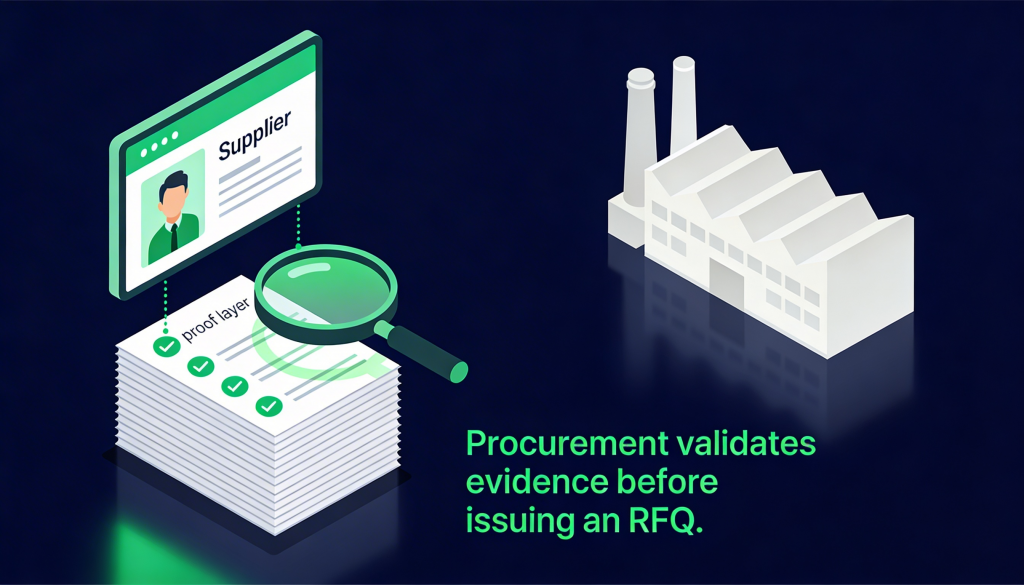
A proof pack is a structured set of pages that makes validation easy. It helps different stakeholders find the evidence they need, in the format they can use internally.
Think of it as a buyer-facing evidence system.
Done well, it reduces the workload for your sales team too — because you stop repeating the same explanations on calls just to earn basic trust.
The six layers of evidence
You don’t need to publish everything at once. But you do need to publish the right kinds of proof in the right order.
1) Trust and legitimacy
Before procurement even gets to capability, they check whether you look like a credible organisation.
That doesn’t mean “big brand” design. It means clear, verifiable signals:
- Where you operate (and what happens at each site)
- What you actually manufacture (not a vague list of markets served)
- Who does what (and how to contact the right team)
This layer is about removing doubt, not impressing.
2) Compliance and standards
In industrial buying, compliance is often a gate.
The key isn’t just listing standards. It’s making scope understandable. Buyers want to know what your certification covers, what it doesn’t, and how it connects to their requirements.
Strong compliance proof typically includes:
- The standard(s) you work to, with plain-language relevance
- Coverage and scope (sites, processes, product categories)
- How compliance is maintained (audits, controls, documentation ownership)
If you serve multiple regulated markets, avoid dumping everything onto one page. Create a clean structure that lets buyers navigate to what applies to them.
3) Capability proof
Capability pages often fail because they read like marketing.
Procurement and engineers don’t need adjectives. They need constraints, controls, and realities.
Good capability proof explains things like:
- What you can hold consistently (tolerances, repeatability)
- How you control quality (inspection steps, gates, traceability)
- Typical lead time drivers (not promises, but factors)
- What you are not set up to do (this builds trust more than people expect)
When you address limitations responsibly, you stop looking like a supplier who will say anything to win work.
4) Application proof
This is where most manufacturers leave money on the table.
Product-led pages are helpful, but they often assume the buyer already knows what they need. Many validation searches start higher up the chain:
- “Can this process handle our environment?”
- “Will this material survive X condition?”
- “How do suppliers prevent this failure mode?”
Application proof pages bridge that gap.
They work best when they are built around constraints — not just industries.
For example:
- “Components for high-temperature environments: what changes in material selection and inspection”
- “Low-defect supply for safety-critical assemblies: how traceability and QA reduce risk”
This is the kind of content stakeholders can send internally with confidence.
5) Performance proof
Many case studies are too vague to help validation.
In manufacturing, a useful case study is structured around constraints:
- What the buyer needed (requirements and risks)
- What made it difficult (tolerances, volumes, compliance, environment)
- What you changed or controlled (process, inspection, documentation)
- What the outcome was (quality stability, delivery performance, reduced defects)
If you can’t name the client, you can still publish decision-grade proof by focusing on the application, the constraints, and the measurable outcomes.
6) Procurement readiness
Even when buyers like your capability, onboarding friction can kill momentum.
Procurement readiness content doesn’t have to be a “how to buy from us” sales page. It can be a quiet, practical set of answers that reduces email back-and-forth:
- What information you need to quote accurately
- What documents you can provide (traceability, inspection reports, certificates)
- How you handle change control, revisions, and quality issues
This layer is particularly powerful for tender-driven environments, where buyers must document supplier choices.
How validation shows up in search
Validation search rarely looks like “best manufacturer”.
It looks like requirement-driven queries — often specific, sometimes unglamorous, but commercially meaningful:
- Standards + supplier + location
- Process + material + tolerance
- Compliance term + manufacturer
- Application + constraint + supplier
The point isn’t to obsess over long lists of keywords.
The point is to recognise the pattern: people search for proof in the language of constraints.
If your site only speaks in product names and capability claims, you’ll miss the searches that decide the shortlist.
Why “low-volume” proof topics matter more in AI-led search
As AI search becomes more prominent, queries are fragmenting into longer, more specific prompts — the kind that reflect constraints, requirements, and risk checks rather than neat, high-volume keywords.
That shift turns “low-volume” proof content into an opportunity: it’s easier to match the exact questions buyers ask when they’re shortlisting suppliers, and it gives your site more surfaces to be cited, summarised, and trusted in AI-driven results.
That’s also why we treat this as part of a broader AI SEO approach — building content that performs not just in classic rankings, but in the way modern search interprets and reuses evidence.
The PDF trap (and how to escape it without losing downloads)
Manufacturers often store their best evidence in PDFs: certificates, data sheets, test reports, capability decks.
PDFs are useful, but they are a poor primary experience for validation search.
Common issues:
- Buyers land on a PDF with no context, no explanation, no next step
- Version control becomes messy (old files linger)
- Internal linking becomes weak (everything points to downloads, not pages)
A better approach is simple:
Make the webpage the authority, and the PDF the attachment.
Publish a page that explains what the document is, what it applies to, what scope it covers, and why it matters — then offer the download.
That way, the content is searchable, linkable, and understandable, while the document remains available for procurement packs.
How to build a proof pack without rewriting your whole site
The goal is not a redesign. It’s proof coverage.
Start by mapping your current site to the six proof layers above. You’ll usually find an imbalance: plenty of product and capability copy, very little compliance scope, application evidence, or onboarding clarity.
A simple way to prioritise is to ask: Where do buyers hesitate?
If the hesitation is “Can you meet the standard?” start with compliance scope. If the hesitation is “Can you do this specific job reliably?” start with application and quality control evidence.
The minimum viable proof pack
If you want momentum, build the first version around pages that serve multiple stakeholder needs:
- A compliance and certifications hub (with scope and relevance)
- A quality and inspection approach page (process, gates, traceability)
- Two application pages based on high-value constraints
- One performance proof page (case or reference-style evidence)
You can expand later. The key is to stop forcing buyers to assemble proof themselves.
Mistakes that make you look less credible
Most credibility losses aren’t caused by a lack of capability. They’re caused by a lack of publishable evidence.
The most common mistakes:
- Overclaiming (“we can do anything”) instead of stating controlled capability
- Scope ambiguity (certifications listed without clarity on what they cover)
- Thin industry pages that don’t mention constraints, proof, or decision-stage concerns
- Hiding the best evidence inside unfindable downloads
A useful rule of thumb: if a claim can’t be verified, it doesn’t help validation.
What success looks like
A proof pack is not a “get more visits” tactic. It’s a “win more shortlists” system.
You’ll often see early wins in quieter signals:
- More impressions for requirement-led queries
- Better engagement on compliance, QA, and application pages
- More enquiries that reference specific constraints (“we need ISO scope for X”, “tolerance control for Y”)
Those are strong indicators you’re becoming easier to validate.
Make validation effortless, and shortlists follow
Procurement validation isn’t random.
If you publish the evidence buyers look for — in structured, searchable pages — you stop relying on persuasion and start earning trust before the first conversation.
In manufacturing, that’s often the difference between being “one of the options” and being the safe choice.