Most B2B buyers do not wait for a sales call to decide what they think of you. By the time they reach out, a preference is often already taking shape. The real question is where that preference gets tested.
More often than many teams realise, it happens when someone searches your brand. Not because they are ready to buy, but because they want to check whether you feel credible, safe and worth taking seriously.
That is what makes branded search visibility commercially important. It is not just about owning your name in Google. It is about what buyers find when they start looking for reasons to trust you — or not.
Why vendor preference forms early and gets shaped before sales gets involved
One of the most important ideas in the research is also one of the simplest. Buyers are not waiting for sales conversations to begin their evaluation. They are doing that work much earlier, and increasingly doing it on their own.
Recent research from Forrester shows that 68% of B2B buyers start with a front-runner vendor in mind, and that vendor goes on to win 80% of the time. Findings from 6sense add another important layer: first contact with vendors typically happens well past the halfway point of the buying journey, which means a large share of evaluation takes place before any outreach.
At the same time, the shift towards self-directed buying is not theoretical. Gartner reports that 67% of B2B buyers prefer a rep-free experience, and 45% used AI during a recent purchase.
In practice, that means buyers are building and testing decisions without vendor involvement. They move between search results, review platforms, AI-generated summaries and peer input, forming a picture of each option before they ever speak to anyone.
By the time a lead appears in your pipeline, it often reflects a preference that has already been shaped elsewhere.
The branded search moment as a validation checkpoint
When a buyer searches for your brand, they are rarely just navigating to your homepage. More often, they are asking a set of implicit questions:
- Is this company credible?
- Can I trust them?
- Will this decision stand up internally?
Branded search is therefore best understood as a validation checkpoint rather than a simple navigational query.
It is important to be precise here. There is no single study that proves brand SERP quality directly causes vendor preference.
However, the combination of early preference formation, self-directed research and multi-source validation strongly supports the conclusion that branded search plays a meaningful role in reinforcing or weakening that preference.
What buyers evaluate when they search your brand
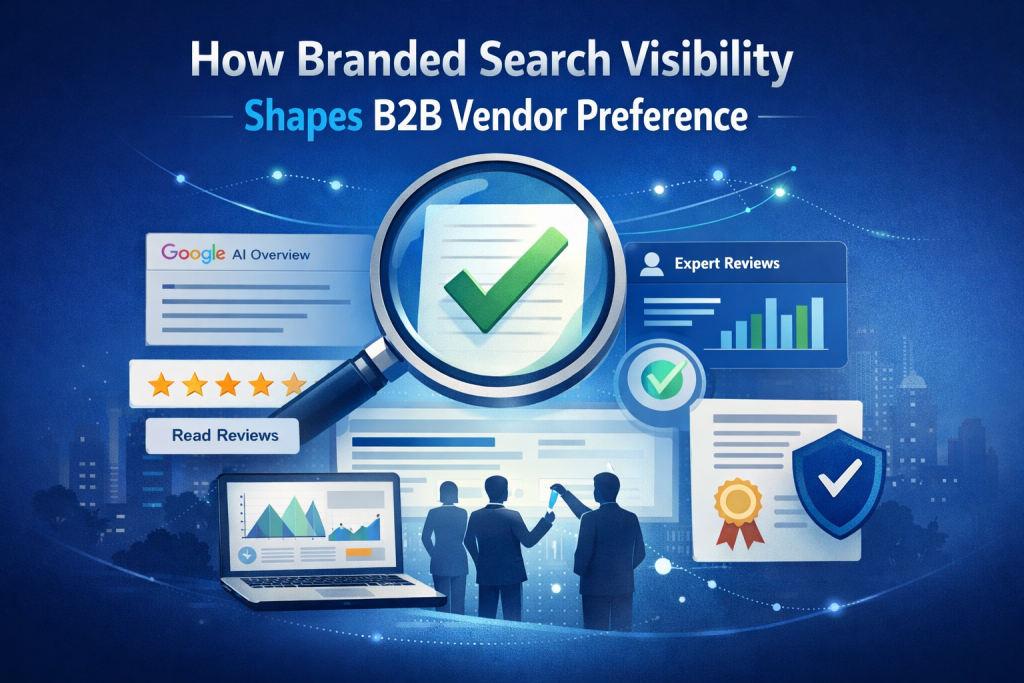
When buyers evaluate a vendor through search, they are looking for a combination of signals.
- Credibility signals help them understand whether the company is real, established and coherent.
- Proof signals show whether the vendor can actually deliver, through case studies, examples or clear service explanations.
- Authority signals come from third-party platforms, reviews and external validation that confirm the company’s reputation beyond its own website.
- Consistency signals ensure that what appears across search results aligns, reducing confusion and effort.
- Reassurance signals support stakeholders responsible for risk, including certifications, security information and procurement readiness.
Together, these elements form a picture that helps buyers reduce uncertainty before taking the next step.
Where branded search visibility creates doubt
Buyers do not need a major red flag to lose confidence. Often, a few small gaps are enough.
A confusing brand presence, missing proof, conflicting information or dominant negative narratives can all introduce hesitation.
In many cases, the issue is not that the company lacks credibility, but that it requires too much effort to confirm it.
That effort matters. When buyers are comparing multiple vendors, the option that feels easiest to validate often gains an advantage.
AI has changed the interface, not the need for validation
AI is now part of the research process, but it has not removed the need for verification.
TrustRadius reports that 72% of buyers encounter Google AI Overviews, and 90% click through to cited sources to validate what they see.
This reinforces an important point. Buyers are still checking, comparing and confirming information. AI may compress the process, but it does not replace it.
For companies, this means that visibility across credible sources and consistency across search results is more important, not less.
Why this matters in complex B2B sectors
The role of branded search becomes even more critical in sectors where risk is high and buying groups are complex.
In IT services, cybersecurity, SaaS and industrial environments, buyers must justify decisions to multiple stakeholders, including technical and security teams.
Research from G2 indicates that IT is involved in nearly half of software purchasing decisions, which raises the standard for visible proof and documentation.
In these contexts, branded search visibility is not just about presence. It is about making it easier for buyers to confirm that a vendor is credible, capable and safe to engage.
The strategic implication most companies miss
Branded search is often treated as a brand protection exercise. In reality, it functions as part of pre-sales decision support.
If buyers are forming and validating preferences before contact, then the quality of your branded search environment directly affects how strong those preferences are when they reach your sales team.
This has implications for pipeline quality, conversion rates and sales efficiency.
How to think about branded search visibility going forward
The most effective way to approach branded search is to treat it as a system rather than a single channel.
That system should make it easy for buyers to:
- Understand who you are
- See proof of what you do
- Validate your credibility externally
- Confirm consistency across sources
- Reduce risk before engaging
The goal is not simply to rank for your name, but to create an environment where a buyer can confidently conclude that your company is a credible and suitable choice.