
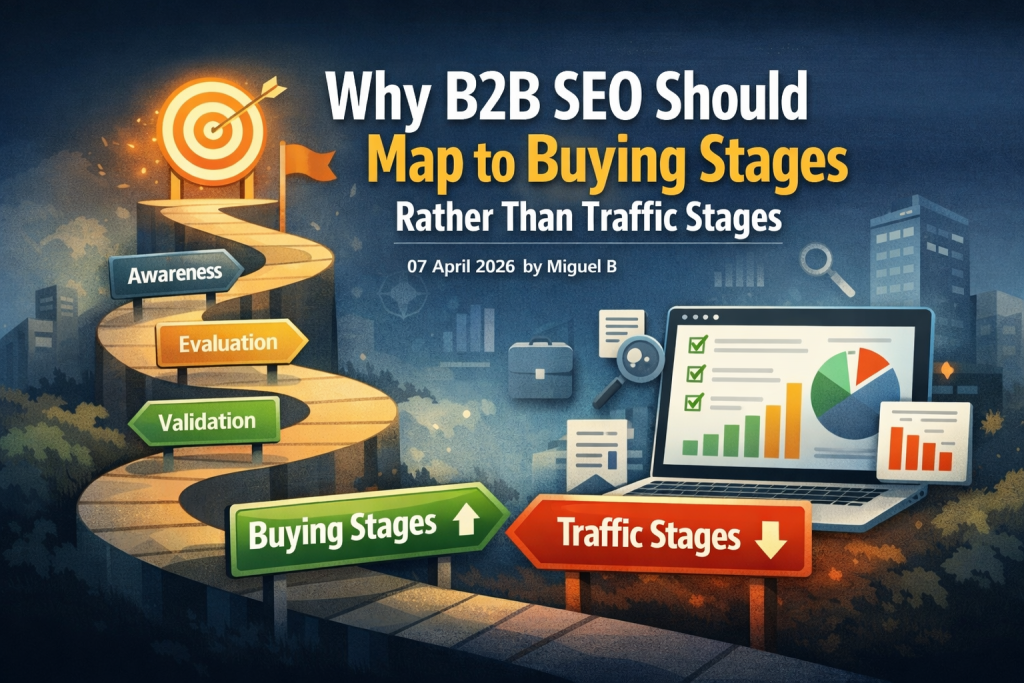
Most B2B SEO programmes are still planned around traffic opportunity. Teams cluster keywords by volume, prioritise what looks scalable, and report success through sessions, rankings and non-branded growth.
It feels rational.
It is also one of the main reasons B2B SEO often looks healthy in a dashboard while contributing less than expected to commercial progress.
That happens because B2B SEO is rarely working inside a simple discovery-to-conversion funnel. B2B buying is slower, more fragmented and more political than that.
Forrester has described this reality as buying mayhem, with 86% of B2B purchases stalling during the process, an average of 13 people involved, and 89% of purchases spanning two or more departments.
Gartner likewise reports enterprise buying groups commonly include five to 11 stakeholders across five business functions.
In other words, the problem is not that buyers need more content. The problem is that they need the right support at the right decision moment.
That is why B2B SEO should map to buying stages rather than traffic stages.
Traffic is still useful.
It can reveal reach, visibility and demand capture. But traffic is a signal, not a strategy model.
In complex B2B environments, search becomes commercially more valuable when it helps buyers define a problem, compare approaches, validate shortlisted options and justify a decision internally.
Why Traffic Stages Create False Priorities in B2B SEO
Traffic stages sound practical because they make SEO easier to organise. They allow teams to separate top-of-funnel, mid-funnel and bottom-funnel opportunities, estimate reachable volume and produce clear-looking roadmaps. The weakness is that traffic stages sort opportunities by acquisition potential, not by commercial role.
That distinction matters more in B2B than in most other environments. A page can attract a large amount of informational traffic and still contribute very little to pipeline progression.
At the same time, a lower-volume page aimed at evaluation, proof, implementation or internal approval can influence much more valuable movement.
When planning is anchored too heavily on volume, the work naturally drifts towards the parts of SEO that are easiest to grow and easiest to report.
That usually means broad informational topics win internal priority. They are simpler to justify in keyword tools, easier to map into content calendars and more likely to generate visible growth in sessions.
The trouble is that this creates a distorted content mix. Teams invest heavily in discovery traffic, then wonder why their SEO programme feels busy but commercially thin.
There is good directional evidence for that problem. In a published Grow and Convert case study based on 64 articles and roughly 232,000 organic visits, bottom-of-funnel content generated 1,348 conversions from 28,190 visits, while top-of-funnel content generated 397 conversions from 204,303 visits ().
That does not mean awareness content is worthless. It does show how badly traffic can mislead prioritisation when volume becomes the main planning lens.
Why B2B Buying Stages Are a Better Planning Model
A buying-stage model starts from a more useful question: what does search need to help the buyer do at this moment?
That is a better fit for B2B reality because B2B journeys are rarely linear.
Academic work in Industrial Marketing Management describes B2B customer journeys as intertwined paths across buying-centre and usage-centre members, moving through direct and indirect touchpoints and often looping rather than progressing neatly in one direction.
That is a much more realistic foundation for SEO strategy than a simplified acquisition funnel.
It also reflects how decisions actually get made. Different stakeholders search for different reasons.
Some are trying to frame the business problem properly. Others are comparing routes, reducing risk, checking proof, or making sure the choice can survive legal, financial or operational scrutiny.
Search intent changes as buying progresses, and the value of a page changes with it.
Seen through that lens, SEO should not be assessed only by how many visits it attracts. It should also be assessed by whether it helps a buying group move, align and gain confidence.
The Four Buying-Stage Roles SEO Needs to Support
Problem Framing
At the earliest useful stage, search helps buyers define what is wrong clearly enough to justify action. Strong problem-framing content sharpens commercial pain, exposes constraints, and helps a team describe the issue in a way that deserves budget and attention.
In B2B SEO, this is where many strategies become too generic. They publish educational content that attracts curiosity but does little to clarify a meaningful business decision.
Approach Evaluation
Once the problem is recognised, search often shifts from definition to comparison. Buyers are no longer looking only for background information. They want to weigh approaches, understand trade-offs and explore which route makes the most sense in their context.
This is where SEO needs to support decision quality, not just demand capture. Comparison pages, strategic analysis, implementation considerations and route-based content can all matter more here than another basic explainer. If a strategy is too traffic-led, this layer is often underbuilt because it tends to carry less volume than broader educational topics.
Vendor Validation
Later in the process, search helps buyers check whether shortlisted vendors are credible enough to move forward. This includes brand visibility, evidence, proof and wider trust signals.
Validation-stage content has a distinct job. It should not be treated as a secondary bonus after discovery content is complete. It is part of the commercial architecture. That is also why branded visibility deserves strategic attention much earlier than many teams assume.
Internal Justification
This is the most underestimated role in many B2B SEO programmes. Search is often used not only to form a preference, but to defend it. Teams need proof points they can share, explain and escalate internally. That means SEO should help buyers justify a choice to colleagues, leadership, finance, procurement or legal.
Demand Gen Report’s 2024 research makes this especially relevant. It found that 72% of buyers share content with relevant team members, and 57% of those colleagues then download and consume that content.
In other words, some of the most valuable content in B2B is not only consumed by the original searcher. It gets passed around the buying group as justification material. In technical sectors, that kind of validation-heavy search behaviour becomes even more visible once buying groups start checking suppliers more seriously.
What Goes Wrong When SEO Is Planned Around Traffic Instead of Buying Progression
When SEO is planned primarily around traffic opportunity, several failure patterns start to appear.
- The first is overinvestment in broad discovery content. Teams build large banks of top-of-funnel articles because those topics are easy to find, easy to brief and easy to defend with search volume.
- The second is underinvestment in evaluation and justification content, because those assets often sit closer to commercial friction and farther from obvious keyword opportunity.
- The third is structural imbalance. Informational and category-style content dominate the roadmap, while the gaps that actually block movement remain open. Buyers can discover the brand, but they are not well supported when they need to compare options, validate claims or build internal consensus.
- The fourth is misread success. Teams celebrate growth in sessions and impressions while ignoring weak shortlist support. If the site is not helping buyers move through the harder parts of the decision, the growth can be real and still commercially underwhelming.
How Traffic-Led Reporting Misreads B2B SEO Performance
Reporting is one of the main reasons the problem survives.
Traffic-led reporting rewards what is easiest to count. Sessions, rankings and non-branded growth create movement in a dashboard, so they become the default evidence of progress. The problem is that these metrics often over-reward early-stage visibility and under-represent later-stage commercial contribution.
A page that attracts thousands of visits may still do little to influence shortlist quality, internal agreement or purchase confidence. A lower-volume page that supports comparison, proof or stakeholder reassurance may matter much more, but appear less impressive in standard SEO reporting.
That is why traffic growth can mask poor commercial alignment. Rankings do not show whether SEO is helping the right stakeholder at the right moment. Session volume says nothing about whether a page helped a buying group reduce uncertainty or move towards approval.
This is not only a theory problem. Content Marketing Institute reports that 56% of B2B marketers struggle to attribute ROI to content and the same proportion struggle to track customer journeys. Only about half say their organisation measures content performance effectively. When teams cannot connect content to pipeline with confidence, traffic naturally becomes the fallback KPI.
There is another blind spot too. G2’s 2024 Buyer Behavior Report shows that public product review websites were the most consulted information source for 31% of buyers, up from 23% the year before, and buyers rated independent review sites as more valuable than analyst firms across the buying journey. A reporting model focused only on on-site traffic can miss a large part of evaluation behaviour. That is one reason branded and validation-stage signals deserve more weight in measurement than standard SEO reports usually give them.
This is also where branded visibility deserves more serious treatment. If a buying-stage SEO model is supposed to reflect decision progression, it has to give more weight to brand searches, review ecosystems and validation-stage visibility than a standard traffic report usually does.
What a Buying-Stage SEO Model Changes in Practice
Keyword Prioritisation Changes
In a buying-stage model, keywords are prioritised by decision-stage role, not just by search volume. That does not mean ignoring high-volume terms. It means refusing to let them dominate simply because they are easier to quantify.
A useful keyword set should include problem-framing terms, evaluation terms, validation terms and internal-justification terms. The goal is not to make every keyword transactional. The goal is to understand which stage of buying progression each topic supports.
Content Planning Changes
Content planning becomes less about filling the funnel with general visibility assets and more about supporting movement through the buying process. That usually leads to a healthier mix of formats: strategic explainers, comparison pieces, proof-led resources, stakeholder-facing pages and supporting decision tools.
In practical terms, that suggests B2B SEO should not stop at content that explains a category. It should also support content that helps confirm and defend the choice.
Gap Analysis Changes
A buying-stage audit asks a different set of questions. Instead of asking only where visibility is missing, it asks where buyers lack support. Are there pages that help frame the problem? Is there enough content to compare strategic approaches? Are proof and reassurance visible enough? Is there anything on the site that helps a stakeholder explain the decision internally?
Those questions often reveal a familiar pattern: discovery is overbuilt, while evaluation and consensus support are thin.
Success Metrics Change
Success metrics also become more honest. Traffic still matters, but it loses its monopoly. A better model looks at stage coverage, stakeholder usefulness, assisted conversion patterns, branded search trends, proof-asset engagement and the way SEO contributes to pipeline movement rather than just pageview volume.
This is especially important in B2B because the audience reachable through search is much larger than the audience ready to buy. If most of the market is not in-market at a given moment, traffic alone becomes a weak proxy for commercial readiness.
How to Audit Your Current SEO Strategy by Buying-Stage Coverage
A practical way to apply this model is to audit your current site by buying-stage role.
Start by listing your main commercial pages and major blog assets. Then assign each one a primary role: problem framing, approach evaluation, vendor validation or internal justification.
From there, look for imbalance. If most of your assets sit in problem framing, you are probably over-weighted towards discovery. If you have very little that helps with evaluation, proof or stakeholder reassurance, the issue is not necessarily low traffic. It may be missing buying-stage support.
Next, compare your reporting emphasis with actual commercial importance. Which pages get celebrated internally? Which ones receive investment? Are those the same pages that help buyers make progress, or simply the ones that make SEO reporting look active?
A strong audit does not only reveal content gaps. It reveals model gaps. It shows whether your SEO strategy is organised around what buyers need or around what dashboards reward.
Why This Matters More in Complex B2B Categories
This framework matters most where buying is harder.
Longer cycles increase the importance of later-stage search support. Larger buying groups create more validation and justification work. Technical, regulated and high-consideration categories are more likely to suffer when SEO is heavy on discovery and weak on reassurance.
That is one reason the model fits CommerceTuned’s positioning so naturally. In complex B2B environments, search is not only a channel for generating visits. It is part of how decisions get shaped, checked and defended. Where procurement, technical review or due diligence play a bigger role, teams often need proof assets that reduce friction rather than just more discovery content.
A Better Question Than How Much Traffic Did SEO Generate
The more useful question is not whether SEO attracted visits.
It is whether SEO helped the right people move forward at the right moment.
Did it help the buying team define the problem clearly enough to act? Did it help them compare strategic routes more confidently? Did it help them validate shortlisted options? Did it help internal stakeholders feel more comfortable approving the decision?
Those questions create a stronger bridge between visibility and commercial impact. They also force a more honest conversation about what SEO is really for in B2B.
If the answer to those questions is weak, more traffic will not solve the underlying issue. It may simply hide it for longer.